Rad Relativity — 2026
A deep dive into the physics of black holes, from Einstein's relativity to rotating Kerr geometry.
He judges you
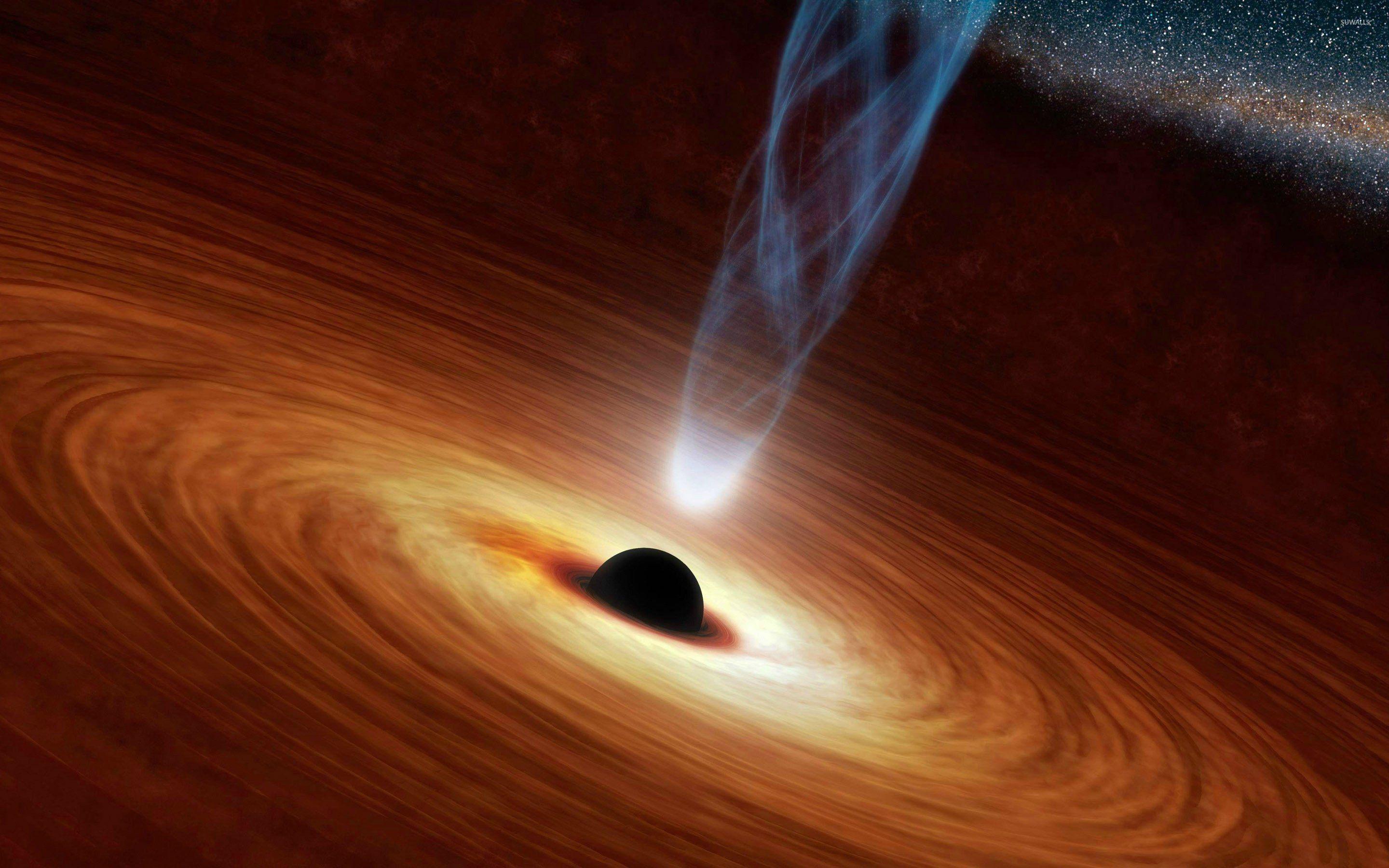
A black hole is a region of spacetime where gravity is so overwhelming that nothing — not even light — can escape once it crosses the boundary known as the event horizon.
They are not empty voids. They contain enormous amounts of mass compressed into an incredibly small space, bending spacetime so severely that our ordinary physics breaks down at the centre.
Predicted by Einstein's general theory of relativity in 1916 and first directly photographed in 2019, black holes remain one of the most actively studied objects in all of astrophysics.
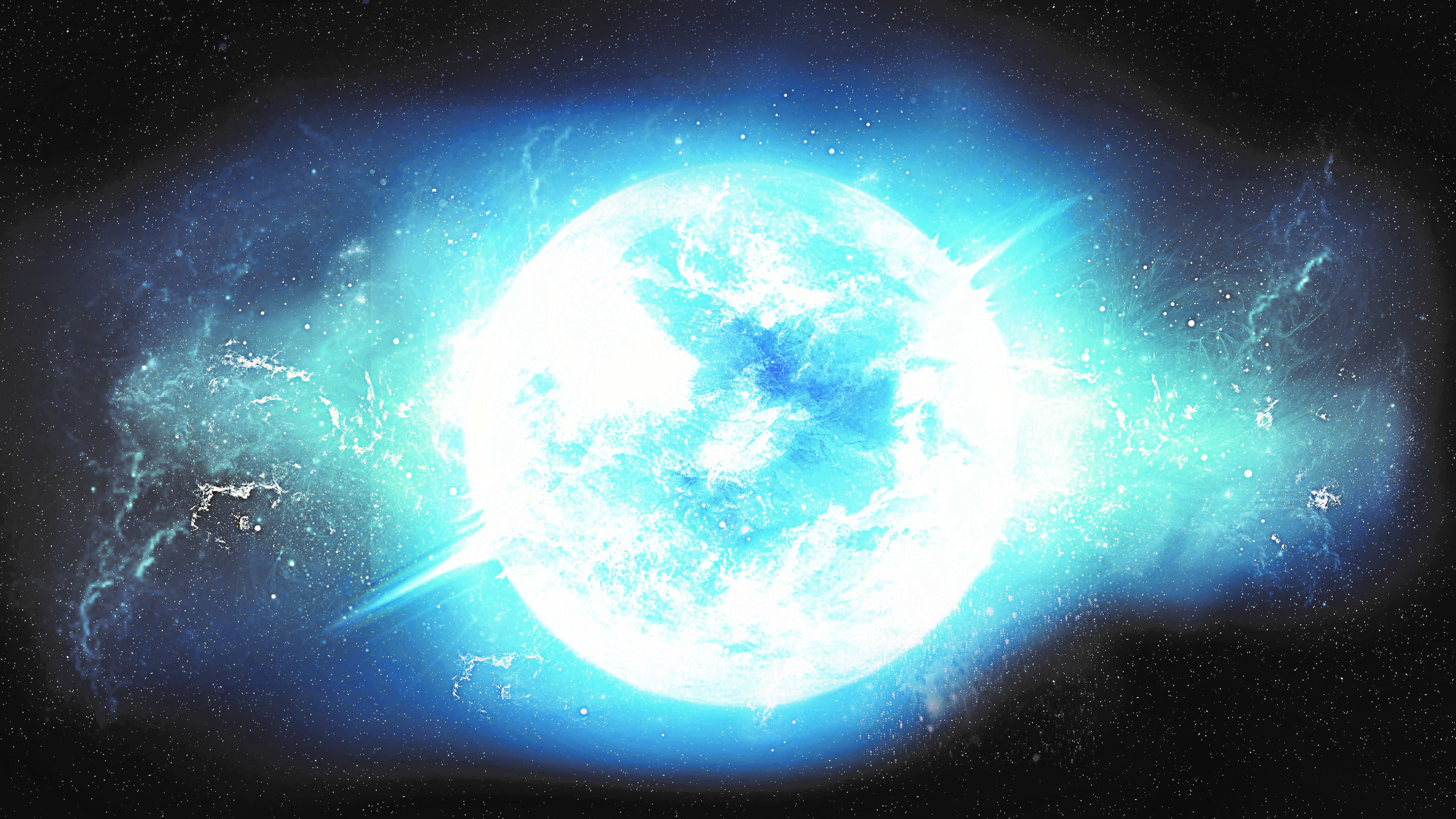
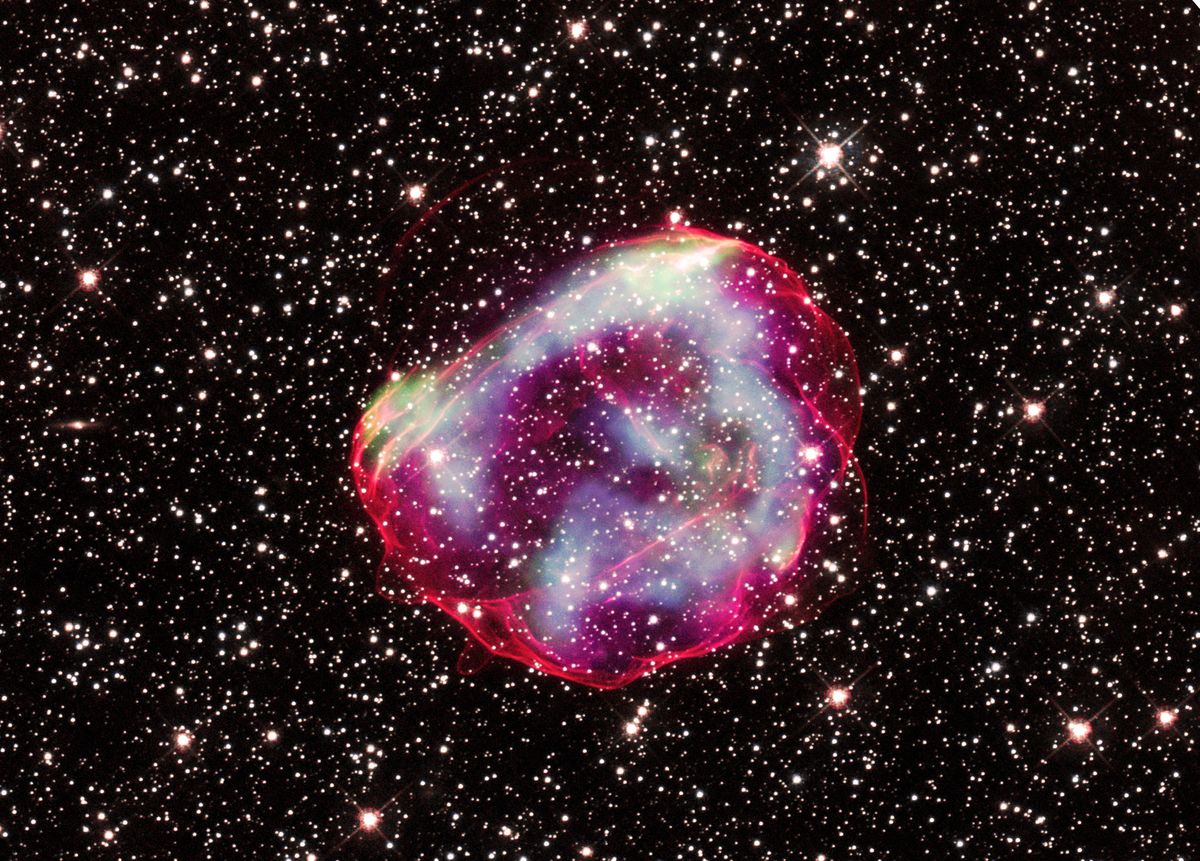
Figure 2 — An artist's depiction of a black hole
Rad Relativity Relativity
A completely reliable and accurate description of Einstein's Theory of Relativity.
The Theory of Relativity is one of the most important ideas in modern physics, developed by Albert Einstein in the early 20th century. It explains how space, time, and gravity work — especially when objects move very fast or when gravity is extremely strong.
Einstein's theory explains that space and time are connected through spacetime, that time is relative depending on motion and gravity, and that mass and energy are related. Both special and general relativity have been tested many times. Relativity is not theoretical.
Disclaimer: All of this is simplified for easier reading and understanding, and is as accurate as possible in this form. — The Author
Covers space and time for objects at constant speeds. No gravity involved.
Extends special relativity to include gravity. Mass curves spacetime.
Special relativity (1905) describes how space and time work for objects moving at constant speeds — no gravity involved. It rests on two postulates:
Imagine you are on a sealed train — no windows, no gaps — travelling at a constant speed. You do not know you are moving. You roll a ball on the floor. It drops to the ground and rolls exactly as it would on solid ground.
From inside, you have no way of knowing how fast the train is moving. Physics behaves identically at any constant speed. The laws of physics are the same in all inertial frames.
This means two observers moving at different constant speeds will each measure the same speed of light — not different values, as classical physics would predict. Einstein's insight was that this forces space and time to be flexible instead.
Length contraction happens when something is moving — but it is only significant at speeds approaching the speed of light. Because space and time are interconnected and the speed of light is constant, the relativity of simultaneity means that light from one end of a moving object reaches an observer at a different time than light from the other end. If you measure the distance between the ends using those arrival times, you get a shorter value. This is the observed length contraction.
$$L = L_0\sqrt{1 - \frac{v^2}{c^2}} = \frac{L_0}{\gamma}$$Mass and energy are two forms of the same thing. A tiny bit of mass equals an enormous amount of energy. And because $c$ is the cosmic speed limit, nothing with mass can ever reach it.
Imagine a ruler and two observers: one standing still, the other moving to the right. A football is thrown to the left. Both measure its speed using their own ruler and clock. The stationary observer measures 50 m/s; the moving observer measures 150 m/s. In classical (Newtonian) physics, both are valid — motion is always relative, and each observer considers themselves "at rest."
Logically then, a stationary observer should measure light at $c$, and a moving observer at $c + 50$ m/s. But Einstein said this is wrong. The speed of light in a vacuum is always the same, regardless of the observer's motion.
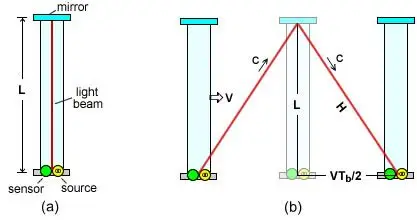
To explore the consequences, imagine a light clock — a beam of light bouncing between two mirrors. Seen from inside a moving train and from a stationary observer on the ground, the same clock behaves differently.
For the rider, the photon travels straight up and down. For the ground observer, because the clock moves sideways, the photon follows a longer diagonal path — while still moving at exactly the speed of light.
As a result, the ground observer concludes that less time has passed on the moving clock. A moving clock runs more slowly. This is time dilation.
In the ground frame, the resting clock's light travels straight between mirrors at distance $d$. The time between ticks is the proper time, $\Delta t_0$, where $d = c(\Delta t_0/2)$. This distance is perpendicular to the motion, so $d$ is the same in every reference frame.
For the moving clock, the photon traces a diagonal path of length $S = c(\Delta t/2)$, while the clock moves sideways $L = v(\Delta t/2)$. The lengths $d$, $L$, and $S$ form a right triangle. Applying the Pythagorean theorem and solving:
$$\Delta t = \gamma\,\Delta t_0 \qquad \gamma = \frac{1}{\sqrt{1 - v^2/c^2}}$$The moving clock's tick interval $\Delta t$ is longer than the proper time $\Delta t_0$ — the moving clock runs slow. The Lorentz factor $\gamma$ is always $\geq 1$.
Proper time is the time measured by a clock present at both events in the same location — essentially the time in the frame where the clock is at rest. It is always the shortest possible elapsed time between those events.
Muons are created when cosmic rays — high-energy particles from space — strike nuclei in the upper atmosphere. At rest, a muon's average lifetime is about 2.2 microseconds; far too short to travel the ~18 km to sea level before decaying.
Logically, muons should never reach the ground. Yet many are observed at sea level, confirmed by experiments on Mount Washington. Using the time dilation formula, their lifetime as seen from Earth can be about ten times longer than their proper lifetime — enough to travel several kilometres and reach the sensors.
The twin paradox: one twin stays on Earth while the other travels at high speed to a distant star and returns. From Earth's frame, the traveling twin's clock runs slow — the traveler returns younger.
From the traveler's view, Earth seems to move, so Earth's clocks appear slow too. Paradox?
The resolution: the traveling twin changes inertial frames at the turnaround — they experience acceleration. The Earth-bound twin does not. When the traveler switches frames, Earth's time coordinate "jumps" forward in the new frame. Over the whole journey, this frame-switching creates a larger total elapsed time for Earth. When they reunite, the traveling twin is much younger.
1915 — Extends special relativity to include gravity. Instead of thinking of gravity as a force pulling objects, mass and energy curve spacetime, and objects move along the curves.
Imagine a single spherically symmetrical object — non-rotating and electrically neutral — alone in an empty universe. Release a ring of stationary particles around it (far away). The particles gradually speed up towards the object until they reach it.
Release more and more streams until you have a uniform flow all accelerating toward the object. Now, instead of particles, think of it as spacetime itself flowing like a river into the object, carrying anything in its path. That is how gravity actually works.
Free fall — like an orbiting planet or a dropped object — is actually the object moving along the "straightest possible path" (a geodesic) in curved spacetime. There is no force pulling it. The path itself is curved by nearby mass.
Every object is already moving through time. Spacetime warping converts that temporal motion into spatial motion — pulling things toward massive objects.
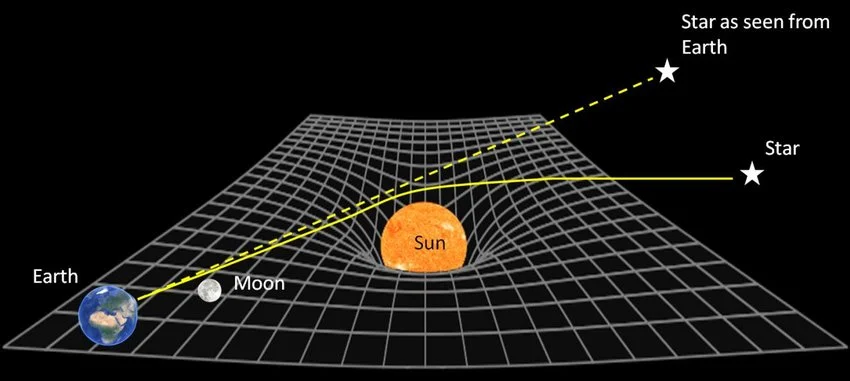
We cannot create a perfectly correct visual for general relativity for one key reason: it includes a fourth dimension. Instead of a spatial dimension, Einstein's theory includes time as the fourth dimension. We can make useful 3D approximations — but they are always approximations.
The sheet visualisation: imagine a perfectly flat, infinitely stretchy sheet with a grid network. Place a large steel ball and a small ping pong ball on it. The steel ball creates a large curve; the ping pong ball rolls toward it, picking up speed.
Now roll the ping pong ball in from the side — it spirals briefly and hits the steel ball. The sheet is spacetime. The steel ball is a planet. The falling ping pong ball is an object under gravity; rolled from the side, it is an orbiting object.
If you shoot the ping pong ball from a massive distance with enormous speed, it whizzes past without orbiting. Control that energy and it enters a stable orbit that decays much more slowly.
A more accurate visualisation uses a full 3D grid or net representing spacetime, pulled and contracted toward the central object — better showing the "river" effect. The full 4D version (including time) cannot yet be perfectly visualised. The most popular 4D approximation is a cube inside a cube with connected vertices.
To look at gravitational time dilation, we look at the Schwarzschild Solution — the spacetime geometry around a single, spherical, non-rotating, uncharged mass. We do not need a big new equation; the time dilation factor is already inside it.
$$ds^2 = -\!\left(1 - \frac{2GM}{c^2 r}\right)c^2\,dt^2 + \left(1 - \frac{2GM}{c^2 r}\right)^{-1}dr^2 + r^2\,d\Omega^2$$The highlighted term $\left(1 - \frac{2GM}{c^2 r}\right)$ appears in the metric's time component. Take its square root to get the gravitational time dilation factor:
$$\text{Grav. TD Factor} = \sqrt{1 - \frac{2GM}{c^2 r}}$$Compare the two time dilation factors side by side:
$$\text{Velocity TD:} \quad \sqrt{1 - \frac{v^2}{c^2}}$$ $$\text{Gravity TD:} \quad \sqrt{1 - \frac{2GM}{c^2 r}}$$Both share the form $\sqrt{1 - (\,\cdot\,)/c^2}$. Equating the inner terms gives:
$$\frac{2GM}{r} = v^2$$This shows that gravitational time dilation and velocity-based time dilation are the same phenomenon, and gives an equation to substitute between them.
Because the speed of light is always constant, time moves more slowly for you to compensate — so the speed of light remains constant from your perspective too. This is why time dilation exists.
Because of this, there is no single "true" time — it is all relative. Some claim the "true" time is measured in a space without any influence from gravity or velocity. This obviously cannot happen in our ever-expanding universe, because everything is under some form of gravitational influence.
Time is relative. Clocks lie. Gravity bends everything — including the passage of time itself. — ME
Rad Relativity History
The history of general relativity
In 1905, Einstein published the special theory of relativity, a theory that would change the world. At the time, it was highly controversial because it contradicted Newtonian laws, and many people thought that was impossible. People were right; almost no one would use this theory at the time. But Einstein, knowing that his theory was correct, realised that Newtonian gravity couldn't be true because it would violate special relativity, so it had to be revised. He concluded that instead of acting immediately, gravitational waves must propagate through space at the speed of light. Einstein used Maxwell's equations of electromagnetism together with mechanics to ensure that Newtonian gravity obeyed the same principle. Einstein performed thought experiments to figure out how gravity actually works. He noticed that he could not derive the solution from his current theory. So he had to work on a completely new theory, one that is more refined and in-depth than the current theory.
Fig. H1 — Einstein's 1905 annus mirabilis papers.
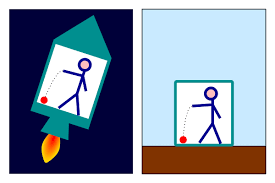
One day, he realises that according to Newtonian gravity, a body in free fall doesn't feel its own weight. Einstein realised that the two things that needed to be equal for this to happen were not a coincidence. He imagined an observer in a sealed box accelerating at a constant rate, realising that there would be no way for the observer to determine if they were in the presence of a large gravitational field or accelerating through outer space. This would be true because they would feel a force pushing them towards the bottom of the box just as gravity would. Einstein called this the equivalence principle. The gravitational force the observer feels is just an authentic homogeneous gravitational field, and the only way for the observer to determine that they are in an authentic gravitational field is to stop accelerating or change the rate of acceleration, and see if they feel anything change. This principle states that physics behaves the same way in all frames of reference in which an observer is accelerating at one constant rate.
Fig. H2 — The equivalence of gravity and acceleration.
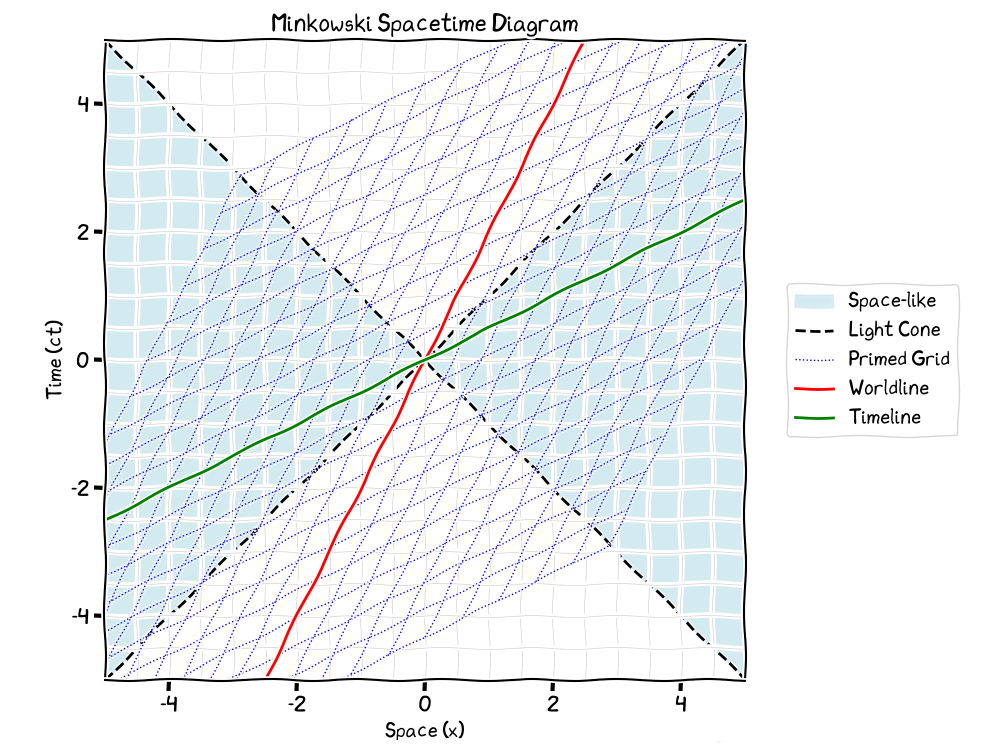
Soon after Einstein realised this, Hermann Minkowski coincidentally developed a four-dimensional formulation of special relativity in which space and time were intertwined. Einstein used this spacetime to develop his theory. Einstein had realised the possibility that a mass would curve the spacetime around it, causing objects to follow a 'straight' path in that curved geometry, causing it to move towards the mass. So, Einstein started doing thought experiments in outer space. He imagined a photon travelling in a stationary rocket from one end to the other, and it travelled straight. Then he applied a constant acceleration of 9.8 m/s² and then shot the photon. Einstein realised that the photon would move very slightly downwards from the perspective of someone inside the ship. Then, using the equivalence principle, he concluded that the photon would move the same distance on Earth as well. He concluded that this happened due to the light travelling in a 'straight' path along a curved spacetime. This led him to conclude that masses pull on spacetime, which causes objects travelling through the spacetime to curve towards the masses.
Fig. H3 — Minkowski diagram.
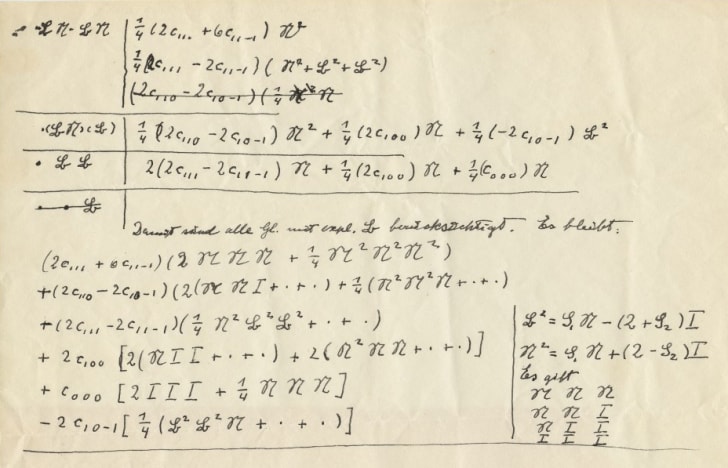
Now all Einstein needed to do was find the correct geometry for this theory and make mathematical equations. When Einstein moved to Zurich, he found that the correct geometry for his new theory was Riemannian geometry, since it applies to curved surfaces rather than to flat ones. To use this, he would have to write his equations to describe motion on curved surfaces. In order to come up with new equations for curved spacetime, he asked Grossmann to help him with the complicated mathematics and said that he would deal with the physics himself. They spent three years working relentlessly until they finished it. This new theory replaced Newton's gravity, and he called it the general theory of relativity.
Fig. H4 — Eienstiens notes.
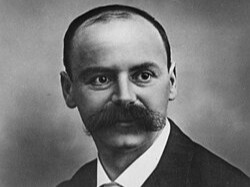
Even though Einstein had the formulas derived and his theory done, he still couldn't find an exact solution to his equations. But the papers Einstein wrote managed to travel to the war zone during World War I, where they reached Karl Schwarzschild. Schwarzschild was delighted to take a break from the war, and he said, in his note to Einstein, "The war treated me kind enough, despite the heavy gunfire, to allow me to get away from it all and take this walk in the land of your ideas." He worked on Einstein's equations by hyper-simplifying the universe to where there is only one mass in the universe, one that is electrically neutral and spherically symmetric. In a matter of weeks, he developed the formula to solve for any curve in spacetime, given that you know the mass and distance to the object; this was the Schwarzschild solution. This solution consequently created the Schwarzschild radius, or the radius an object must be compressed to for it to become a black hole.
"The war treated me kind enough, despite the heavy gunfire, to allow me to get away from it all and take this walk in the land of your ideas." — Karl Schwarzschild, letter to Einstein, 1916
Fig. H5 — Karl Schwarzschild, who solved Einstein's equations from the front.
After Einstein received the letter from Schwarzschild, he was delighted with the findings, but after the solution was released to the general public, two flaws in his solution were uncovered. When r = rs (when the radius is the Schwarzschild radius), or when r = 0, the escape velocity shoots up to infinity. These points are two very important parts of a black hole: the famous event horizon and the singularity. The main issue here was the event horizon — the event horizon is the point where time stops flowing forward, but inward, the line where time stops. But Einstein thought such a thing could never exist, others thought it went against the laws of "Nature," and there would be a thing stopping that from happening. So began the great research of disproving and proving black holes.
Fig. H6 — Don't know what to put here so here is a sea cucumber.
Now Pauli's exclusion principle states that no two fermions, such as electrons, can occupy the same space. What does this mean? Well, since Heisenberg's Uncertainty Principle states that you cannot know both a particle's momentum and position with absolute certainty, and as each electron gets constrained in space, its uncertainty in momentum would have to increase, therefore causing it to vibrate and wiggle around faster and faster. Because the white dwarf was becoming so condensed, the atoms were vibrating so much that they prevented the star from collapsing any further. This is known as the Chandrasekhar limit, equivalent to about 1.44 solar masses.
Fig. H7 — Electron degeneracy pressure holding up a white dwarf.
Now, as the world breathed a sigh of relief, a scientist by the name Subrahmanyan Chandrasekhar was going to prove that statement wrong. He was an Indian astrophysicist, only 19 years old, and while travelling on a British ship in 1930, he found out that a star can collapse past the white dwarf and pass the Chandrasekhar limit. People discovered that when a huge star passes the Chandrasekhar limit, the atoms cannot vibrate faster than light, and they can not hold the star up, and it collapses further. This causes the protons and electrons to fuse, forming neutrons and neutrinos through neutronization, and collapse into a neutron star. However, there is a limit to neutron stars to prevent them from collapsing as well. The Tolman-Oppenheimer-Volkoff or TOV Limit is approximately 2.17 solar masses.
If the star is past the TOV limit, there is nothing to keep it from collapsing, and it folds inwards on itself. At this point, the radius is below the Schwarzschild radius, and it has become a black hole.
Fig. H8 — Stellar collapse: white dwarf → neutron star → black hole.
Rad Relativity NON-ROTATING BLACK HOLES
Now, as you know at this point, Black holes are objects that form under intense conditions in which matter is compressed into a single point, becoming so dense that, from a certain distance, not even light can escape. As we have said a couple of times now, time stops at the horizon, but unlike what Einstein thought, things can still enter the black hole. But what happens when you go into a Black hole? What happens when you reach this singularity?
Now, an outside observer would see time stop for the person entering the hole. As the person got closer and closer, time would slow down more and more, the movement would become slower and slower, and then when they reached the black hole. They stop. They are frozen at the event horizon of the black hole, and they slowly undergo a process called redshift. Their body would become redder, and redder as it leaves the visible light spectrum, shifting to infrared, to microwaves, to radio waves, and finally out of view from any of our technology. But why does this happen? By slowing down time, their light waves get stretched into lower wavelengths. This happens before Spaghettification even happens, the gravity changes just enough in two areas to provide an almost pre-Spaghettification for very tiny objects, as the wavelength loses energy. To understand why an outside observer would see everything freeze at the horizon, we will need to understand light cones.
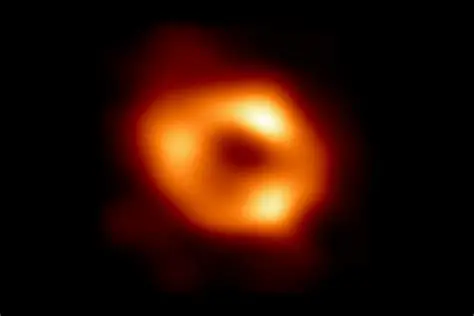
Fig. 8 — Sag A.
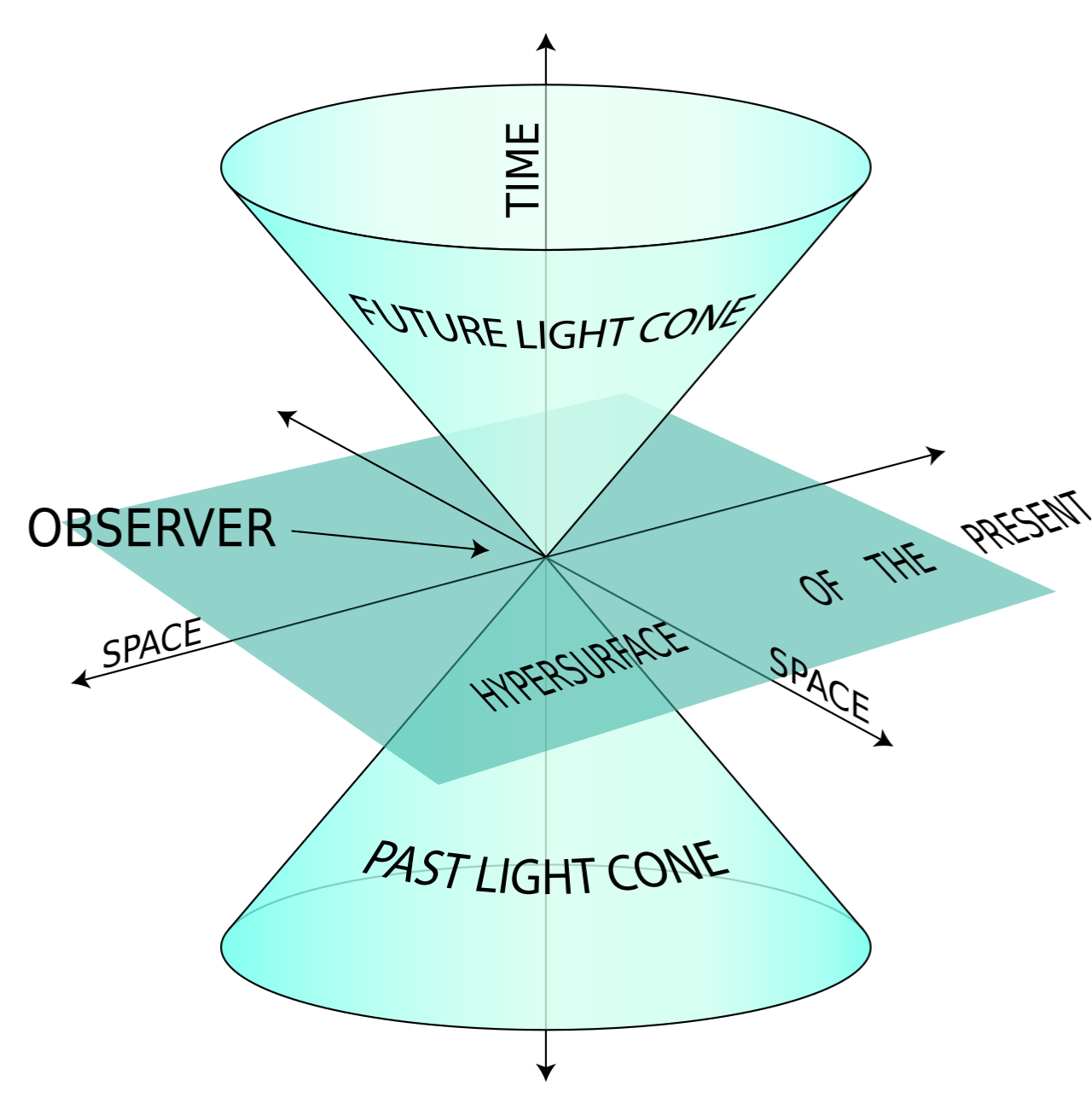
Imagine you are in empty space and a flash of light emanates from your head, causing an ever-expanding sphere where the light was now, because nothing can travel faster than light. Everything that will ever happen to you will happen inside this bubble. We can cut down space to two dimensions and add time as an up and down dimension. What results is, as you move through time, or upwards through it, light spreads away, resulting in a cone on our graph. If we simplify this further, cutting the space down to just one dimension, distance, we get our light cone.
Now, if you have two events in time, anywhere in time, but one is the "you" part of the light cone, the point in time where the cones converge, and one is out of the light cone. They could not have affected each other. You see, events can only affect each other, or influence each other, if they are in each other's light cone. But if you are near a mass where spacetime is curved, you need to take into account the geometry and must therefore use Einstein's equations to determine the spacetime curvature.
Fig. 9 — Light cone.
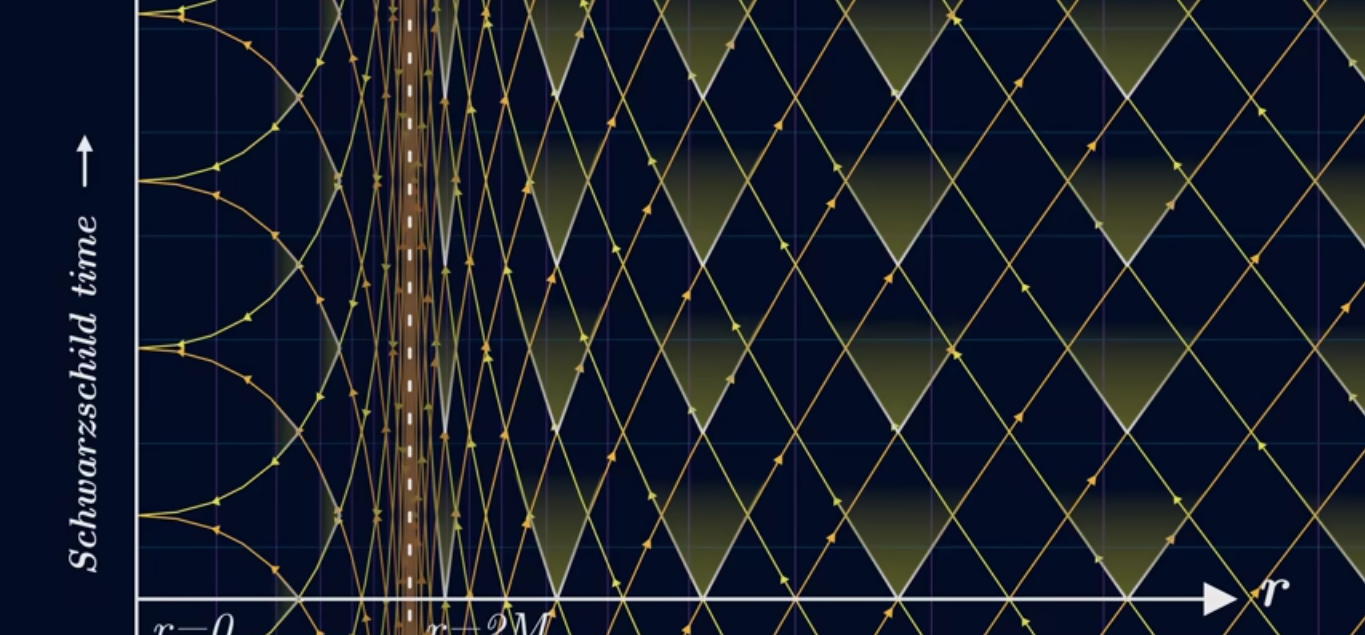
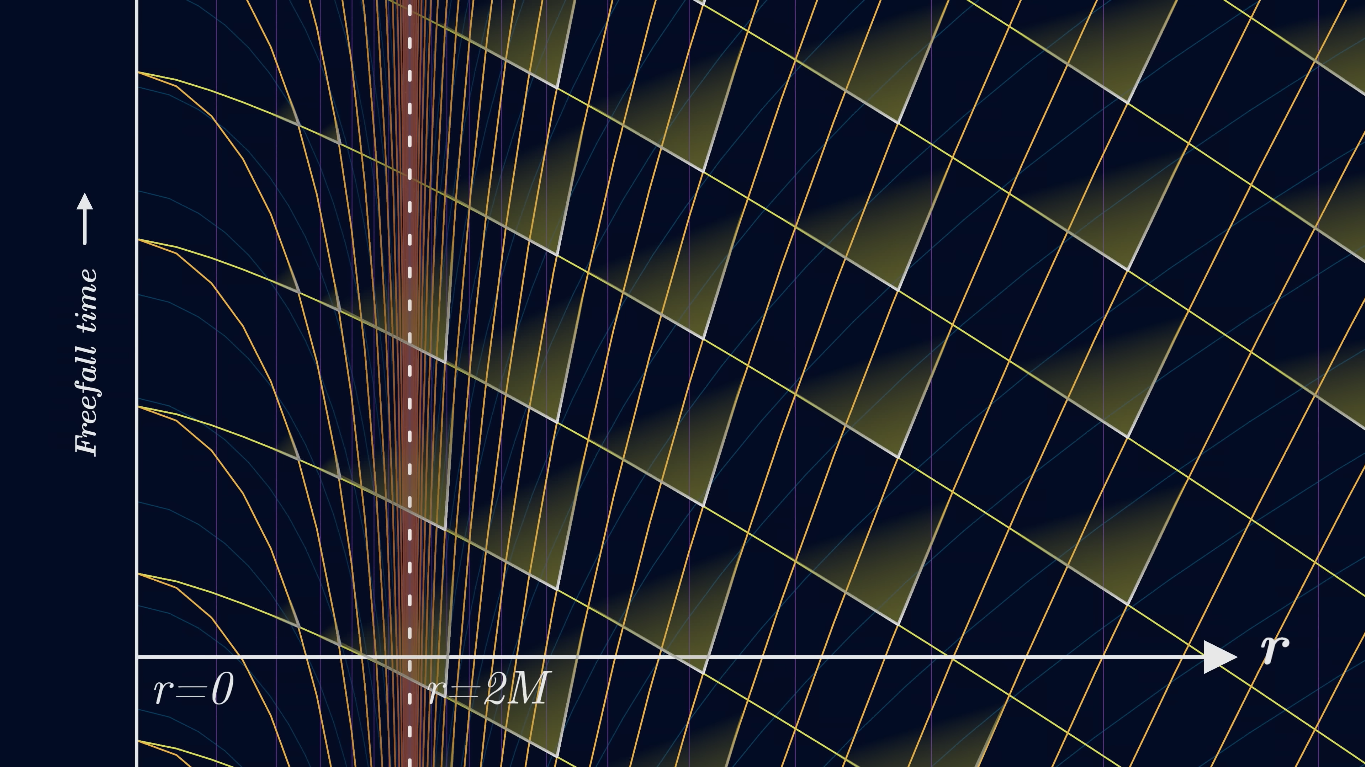
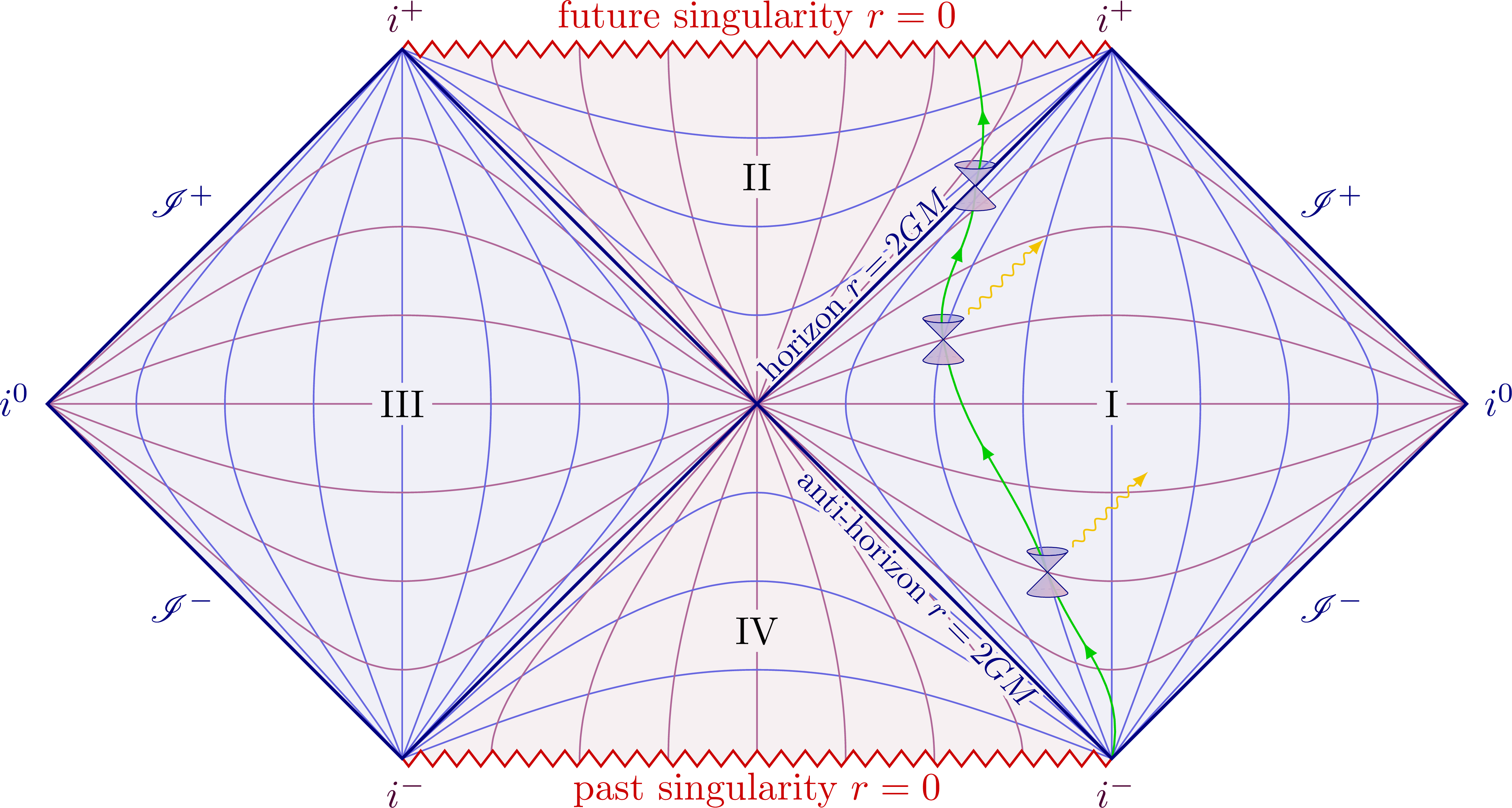
Now that you know this, we can explain why the math proved that nothing could enter a black hole. This is a spacetime diagram where r=0 is the singularity, when the radius is 0, and r=2M is the event horizon, and since the black hole isn't moving, time moves straight up. Now, if we draw incoming and outgoing light rays and see how they travel, we see that your future light cones point at 45° angles, and as we get closer to the event horizon, they start becoming narrower and narrower, as the distance that light can travel away, becomes less and less, until they point straight up at the event horizon, before pointing left towards the singularity after that. Now you might notice something strange about these incoming light rays. They never reach r=2M and instead asymptote at it as time goes to infinity. Yet they come back down and go towards the singularity, as they are mathematically connected. At this point, you might start to recognise the problem. Let's have someone falling into the black hole. Connor, as we will name him, would be forever trapped at the event horizon.
This troubled Einstein and many other scientists deeply, because how could a black hole form if nothing could ever enter it? Oppenheimer proposed a solution to this problem by saying that, to an outside observer, nothing can be seen entering, but if you were the one traveling in, you would pass through it.
If you haven't realized so far, the problem was the light cones. Look back at the previous graph. The light travels the same distance going away and into the black hole. The light is being slowed down in all directions. To change this, we need a modified equation.
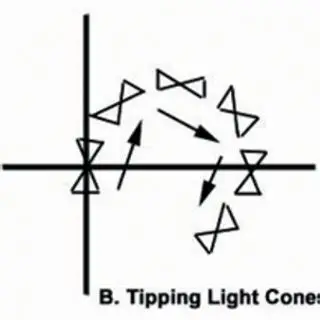
This changes the graph so that it is accurate to what happens to the light. If you see, the light cones tip inward, a very important detail that will explain later events. Now, this shows that there isn't a physical object at the event horizon, and what we saw was just a poor choice of a coordinate system and perspective.
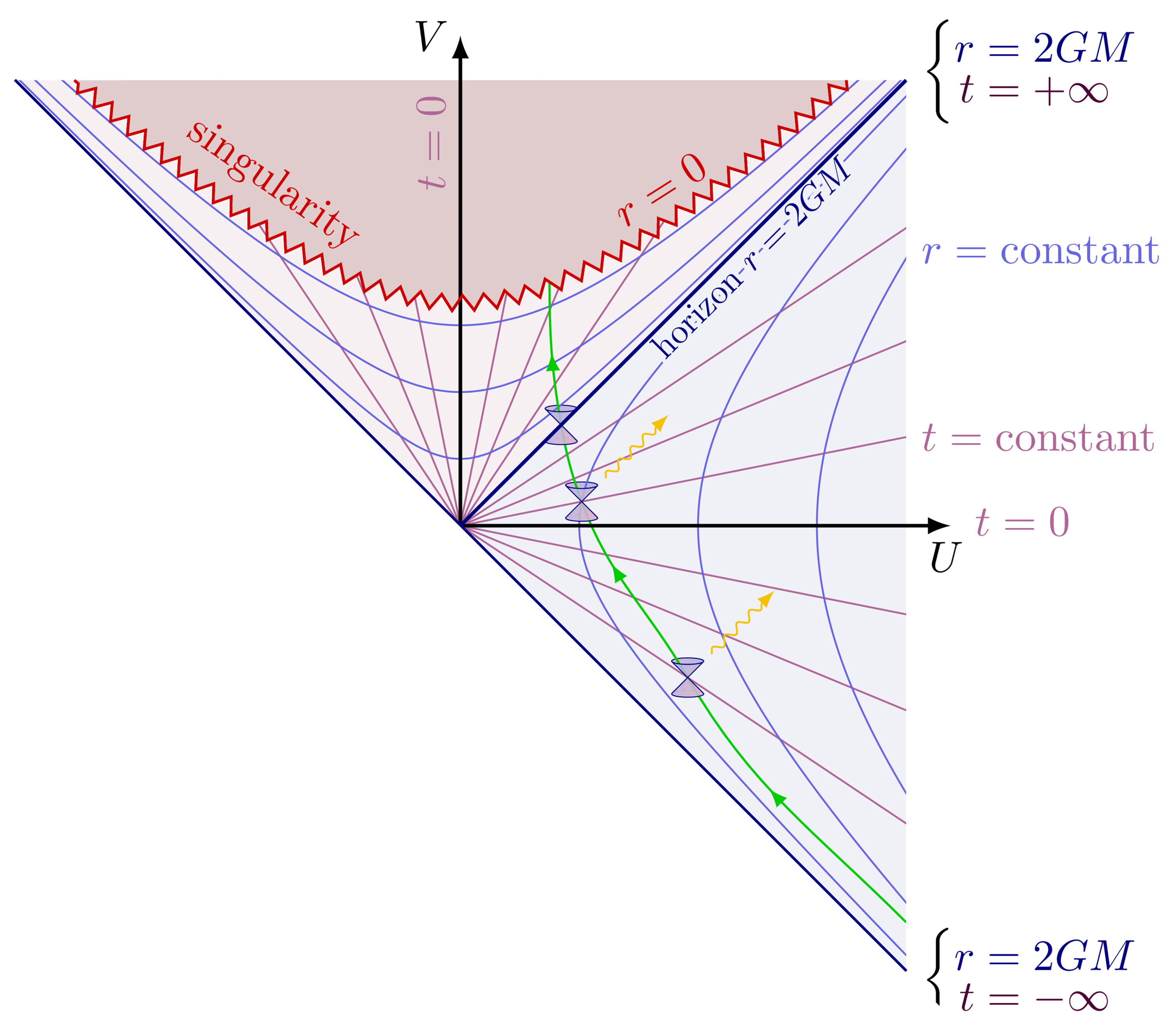
If you change the black hole graph so that all of the incoming and outgoing light rays travel at 45° angles, then the singularity would get this curve, and you would see that the singularity becomes a moment in time instead of a place in space, explaining why the light cones tilted inwards after they crossed r=2M. This is called a Kruskal Diagram.
Fig. 10a — The Schwarzschild spacetime diagram.
Fig. 10b — lightcones tipping inwards.
Fig. 10c — The Kruskal spacetime diagram.
The problem with this graph is that it shows a very limited view of the universe, the black hole, and space near the event horizon. But what if we somehow could shrink the whole universe onto one page?
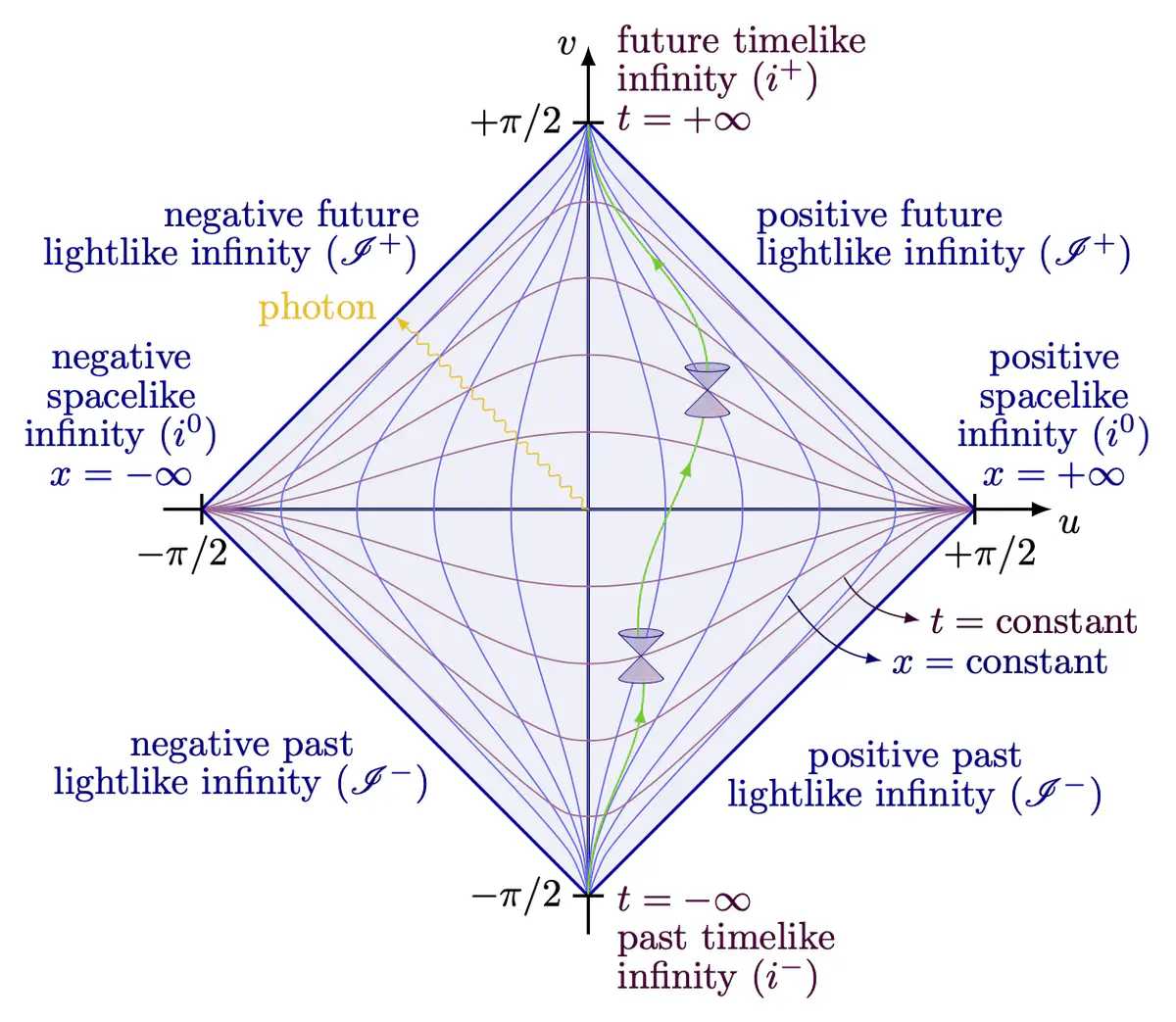
Now the Penrose diagram is a very special thing. What you are looking at is the whole Universe. Near every edge of this diagram, the distances shoot to infinity, but what distances? Just like in the light cone explanation, the Penrose diagram uses two dimensions, distance, and time. To the right and left, the x-axis, or distance, it oscillates to spacelike infinity. The same happens with time, or the y-axis, as it goes up or down, it oscillates to timelike infinity or near future or past. There is one very important thing about this diagram, which will use a lot to prove things. In this graph, light always travels at 45-degree angles.
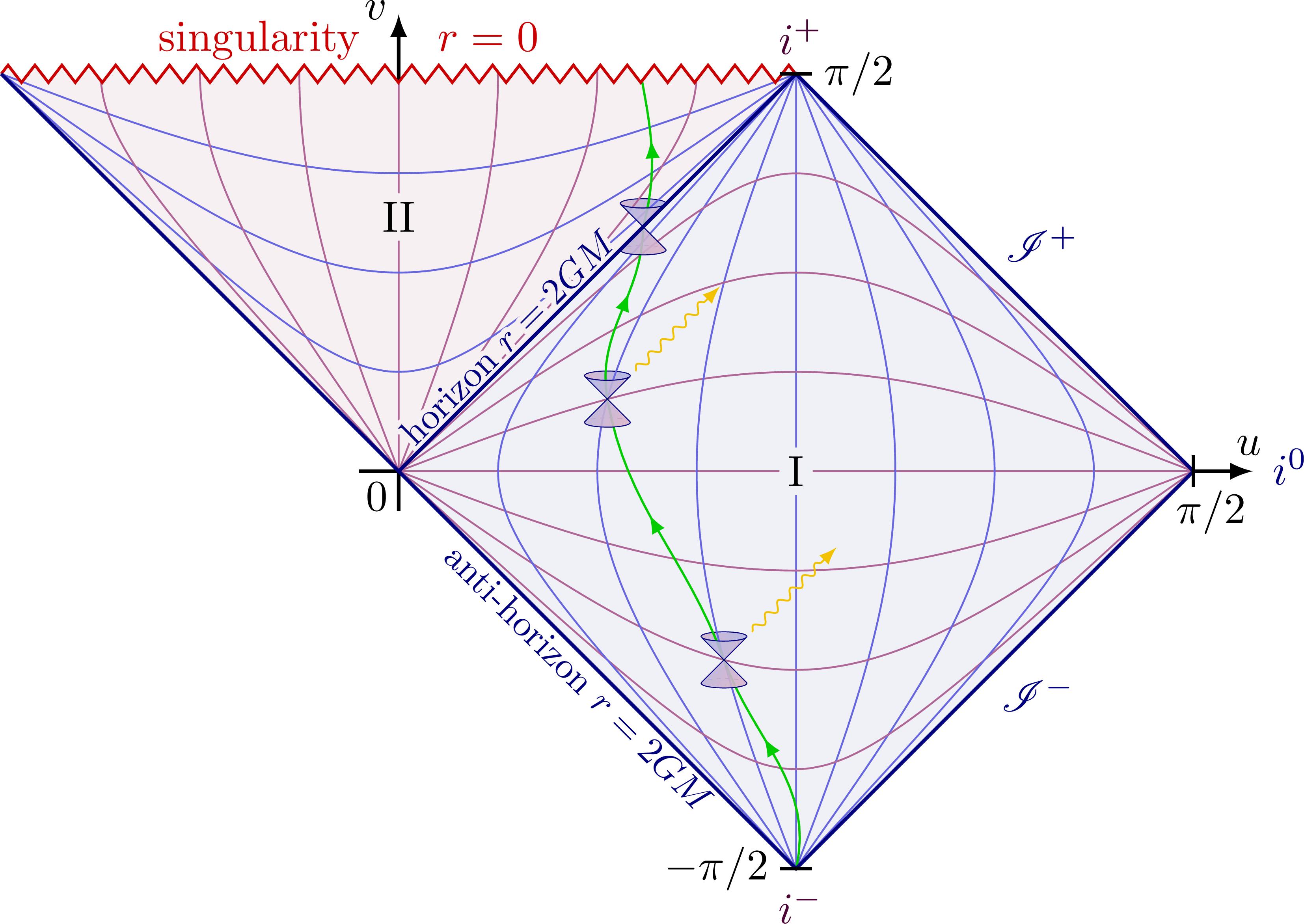
If we take this Penrose diagram and combine it with our Kruskal diagram, we can create something that has every single thing we need in it.
Through changing the graph, we have retained everything from the last graph, but by just changing the proportions of the lines on this image, we now have the entire universe trapped on a page. Here, you can see that the singularity is a flat line across the top, and our universe is to the right. Some strange things happen within the black hole. Time & distance switch axis in this graph, and in real life, this is shown by mysterious properties of the singularity. But before we go into that, let's provide some examples of what we could do with this graph.
Now, let's return to Connor. Let's say before he was destined to hurtle into space, he made a jetpack that, when put on him, could propel him forward at half the speed of light. (It also, for this example, made him immortal.) Then, he was launched into space, directly at a black hole. Now, Connor's "Light cone", or for him, Connor's body velocity cone, would be half of the light cone's, with lines at 22.5 degrees each. When the full cone is opposed or blocked by the event horizon, there is no future in which he is not destined to fall into a black hole. Because the max speed he can fly away at is half the speed of light, he will be trapped long before the event horizon. Once he is trapped and has crossed the event horizon, he is destined to hit the singularity.
When he crosses the event horizon, the spatial dimension inwards and the dimension of time swap qualities. This causes the effect of the singularity becoming a point in time, like "tomorrow", instead of a point in space, and now, all directions lead to the singularity. By accelerating in any direction, you will now just speed up the time it takes to reach the singularity. We can see this in the Penrose diagram: when he accelerates in any direction, he will actually decrease the distance needed to reach the singularity. When you hit the singularity, time ends, and there is no future. An immortal being like Connor would never continue his endless journey, and his time would end with nothing he could do to change that.
Fig. 11a — Penrose diagram.
Fig. 11b — Penrose diagram of a Schwarzschild black hole.
Let's go back a bit, when Connor was about to cross the event horizon. He could still send and receive signals from the universe until he entered, when no signals could be sent from him, but he could still receive them. This is determined from his light cone. If you position Connor across the Penrose diagram, you can find what he can receive and give signals to, with his two light cones. But what if we place him at zero (or the bottom of the black hole part)? All he could receive from is that empty space below. This is where white holes come in.
Below the black hole would be a white hole. A point that nothing could enter and would have an intense push, almost like a mountain warp in space-time. This point would be superheated and would be constantly expelling light and gases. Inside a white hole, you could not see the universes outside, and could not predict the future. Now, white holes break certain laws, but it is believed that we do not know enough about this.
So now that we have gotten two points that can warp space-time, what else is there to add to this diagram? Well, if you fully solve Einstein's equations, you get two full spaces, two universes. This is represented in this diagram in the empty space on the left side. By now, our graph looks a bit like this.
White holes represent regions where matter can only emerge, never enter — the temporal mirror of black holes. — General Relativity
Fig. 12 — Schwarzschild extension with a white hole, and alternate universe.
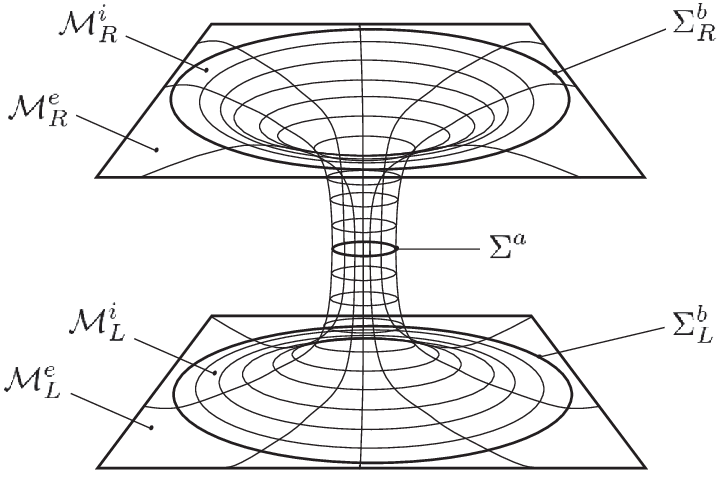
Wormholes appear in the Schwarzschild extension as connections between two universes. In the Penrose diagram, the two corners of separate universes touch across the bridge.
A static Schwarzschild wormhole is unstable. Any matter entering it is destined to hit the singularity before it can pass through, so it is not a viable travel route in this idealized case.
But how do we get to this new universe? Well, that's where Einstein-Rosen bridges come in. These bridges between universes are more commonly known as wormholes. You see that right in the middle of the graph, you have the two corners of universes touching each other? That is where the wormhole lives on our diagram. Unlike Lorentzian wormholes, Einstein-Rosen bridges are unstable connections between universes living inside black holes. But if we can access them in black holes, why can we not travel to another universe? Well, if you look at the Penrose diagram, you will see that the light cone can never reach it from any point in our universe. This is because, as you enter a wormhole, the passage elongates, getting more and more stretched out, until it cuts off, revealing a singularity. This means that to travel through a wormhole, you would have to go faster than light.
So you can't go to the universe because you can't go faster than light. But even if you can't travel to the other universe, it doesn't mean that a black hole is not a connection point between these universes, meaning it is totally reasonable to meet in a black hole, if you are fine with the impending doom of the singularity.
You could meet people from other universes, and white holes and worm holes are things, but what if there was another way to visit a universe? Most black holes are not stable and non-rotating Schwarzschild black holes like we just described. Black holes are mainly Kerr black holes, or spinning black holes, which leads us into our next topic.
Wormholes connect distant parts of spacetime, potentially allowing shortcuts through the universe. — Einstein-Rosen Bridge
Fig. 13 — Wormy hole.
Rad Relativity Rotating Black Holes
A comprehensive guide to Kerr black holes — the rotating solution that describes real stellar black holes, and the exotic physics that occurs within them.
Kerr black holes are different from Schwarzschild black holes. According to Noether's theorem, angular momentum must be conserved in any physical system. Considering stars rotate, then so must stellar-formed black holes. Kerr black holes are stable, spinning black holes.
You might think that the solution for a spinning black hole wouldn't take long to develop, since Schwarzschild found a solution in just a week. But it took almost half a century. This solution, found by Roy Kerr in 1963, is much more complicated than the one Schwarzschild found and includes many more parts than a Schwarzschild black hole. A Kerr black hole is only symmetric along its axis of rotation, as it bulges out at the equator, and instead of having only one layer, a Kerr black hole has three main sections: the ergosphere, the outer horizon, and the inner horizon.
The Schwarzschild solution was elegant — a single static mass simplified into spherical symmetry. A rotating black hole breaks that symmetry entirely. The mathematics becomes vastly more complex. Roy Kerr's 1963 breakthrough opened an entirely new field of study in relativistic astrophysics.
For every continuous symmetry of a physical system, there is a conserved quantity. Rotational symmetry conserves angular momentum. Stars rotate. Collapsed stars retain that rotation. Therefore, real black holes must be Kerr black holes.
Unlike a Schwarzschild black hole with a single event horizon, a Kerr black hole has three distinct regions. The geometry bulges at the equator due to the spin, and in a Kerr black hole, instead of spacetime just falling into the black hole, it gets dragged around along with the spin.
In the Kerr black hole, spacetime gets dragged around along with the spin. When you enter the ergosphere, spacetime moves faster than the speed of light, making it impossible to remain stationary relative to distant stars. You are forced to rotate with the black hole.
However, it is still possible to escape the ergosphere — since spacetime is not collapsing straight into the black hole, just being pulled around it, you can still push out and return to the universe if you have enough velocity.
If you keep flying towards the centre of the black hole, you will enter the outer horizon. Like a Schwarzschild black hole, this is the point of no return. No matter how hard you try, you can never leave the black hole. Every direction you could travel leads only inward.
If you keep flying into the black hole past the outer horizon, you will cross the inner horizon, where you can now feel weightlessness, as if you were far away from the black hole. This is a region with no equivalent in a Schwarzschild black hole.
And now, as you would think, you are doomed to the singularity. But because of angular momentum, the singularity has expanded to a ring. Because of the spin, it is possible to avoid the singularity entirely — you do not have to collide with it head-on.
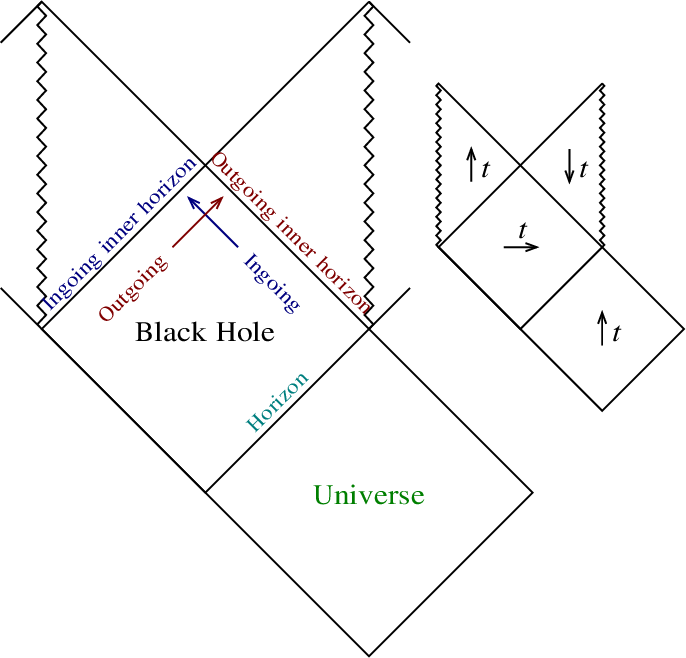
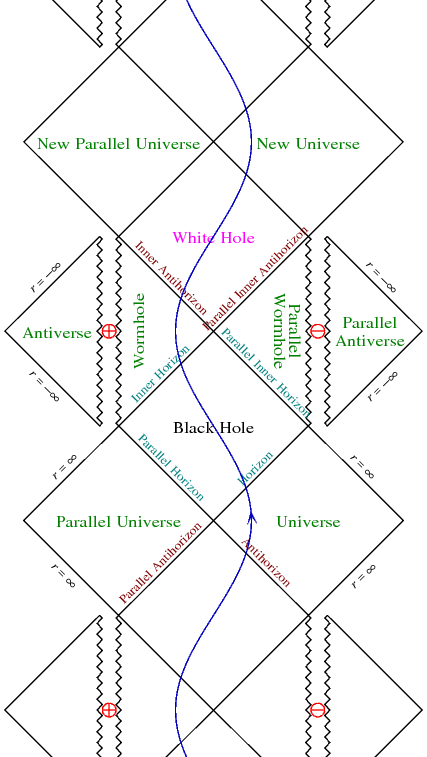
To compensate, we must update the Penrose diagram. The singularity opens up, becoming two lines on the sides of the diagram rather than a single horizontal line. Now you can go past the inner horizon and escape the singularity. After you pass the inner horison and avoid singularity, you pass through the black hole, leading to a corresponding white hole. This white hole opens intotwo universes of its own, and has a kerrblack hole itself.
All of this is infinitely repeatable — meaning there would be infinite universes accessible through this structure. Now, if you went through the singularity, you would end up in a very strange place where gravity pushes instead of pulls. This is called an anti-verse.
A Schwarzschild singularity is a single point at r = 0. A Kerr singularity expands into a ring, oriented perpendicular to the axis of rotation. Because the ring can be navigated around, paths through the interior that avoid the singularity become mathematically possible.
In a Schwarzschild black hole, the singularity is a horizontal line across the top of the Penrose diagram. For a Kerr black hole, the singularity opens — becoming two lines on the sides. This allows paths through the interior to continue past the inner horizon into new regions.
Figure ? — The start of the Kerr diagram.
The mathematics of the Kerr solution then suggests something almost unbelievable.
If you went through the singularity, you would end up in a very strange place. Gravity reverses direction — it pushes instead of pulls. This is the anti-verse. All familiar physical laws are inverted in this region.
The mathematics is consistent with the Kerr solution, but the physics is entirely speculative — no observer could exit such a region to report back.
These structures — infinite universes and anti-verses — emerge from the mathematical solution of the Kerr metric. Real astrophysical black holes are surrounded by matter, turbulence, and radiation. The exotic interior geometry may be significantly altered by physical effects we are still working to understand.
Figure — Kerr interior structure - full.
Rad Relativity / Data
Key measurements, physical constants, and a reference directory of notable black holes.
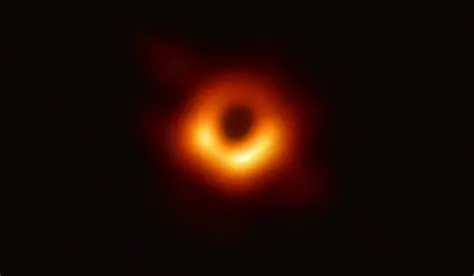
Fig. 13 — M87
The equations that govern black holes, rendered in full. All notation follows standard relativistic conventions where $c = G = 1$ unless stated.
$$r_s = \frac{2GM}{c^2}$$| Name | Type | Mass (M☉) | Distance | Notable for |
|---|---|---|---|---|
| Sgr A* | Supermassive | ~4,000,000 | 26,000 ly | Centre of the Milky Way |
| M87* | Supermassive | ~6,500,000,000 | 55 million ly | First black hole ever photographed |
| TON 618 | Supermassive | ~66,000,000,000 | 10.4 billion ly | One of the most massive known |
| Cygnus X-1 | Stellar | ~21 | 7,200 ly | First confirmed stellar black hole (1971) |
| GW150914 remnant | Stellar | ~62 | 1.3 billion ly | First LIGO gravitational wave source |
| V404 Cygni | Stellar | ~9 | 7,800 ly | Most active X-ray binary in Milky Way |
| HLX-1 | Intermediate | ~20,000 | 290 million ly | Best intermediate-mass BH candidate |
| Holm 15A* | Supermassive | ~40,000,000,000 | 700 million ly | Among the largest ever measured |
Rad Relativity Problems
What did this crazy man get wrong?
Could all of these universes, anti-verses, and white holes really exist in nature? The only problem with all of this is that the Penrose diagram applies only to a static universe, with the only celestial bodies being the black hole and the white hole, both of which must be eternal. In real life, there are many other gravity influences, and according to the second law of thermodynamics, black holes lose mass through Hawking radiation.
According to quantum field theory, "empty" space is not truly empty; it is filled with constant quantum fluctuations. These fluctuations take the form of virtual particle pairs that appear and destroy each other. Near the black hole, one of the particles may fall into the black hole, and the other escapes. This particle is considered to have negative mass, as it had "borrowed" some from space to appear. Normally, this is resolved by the particles merging, but when it falls into a black hole, the black hole loses a tiny amount of mass.
This means that a black hole with a solar mass of 1 will take 1 × 10⁶⁴ Earth years to disappear. That is over 10⁵⁰ times longer than the current age of the universe. Small black holes are around 50-100 solar masses, for comparison, and supermassive black holes are anywhere from 100 thousand to 10s of billions of solar masses.
The second law of thermodynamics states that the total entropy of the universe can only rise, leading to the “heat death” of the universe, where there is permanent thermal equilibrium. Entropy is the measure of molecular disorder, or unavailable energy within a closed system.
Another problem is at the inner (Cauchy) horizon of a Kerr black hole, an infinite flux of energy, caused by light building up, would occur, as matter would blueshift, or compress, infinitely to higher frequencies, thus causing a wall with infinite mass. A person falling into the inner horizon would see the entire future of the universe, as light from later on in time "catches up" to them and blue shifts up to infinity.
In 1990, Eric Poisson and Werner Israel found out that this blueshifting creates a Mass-Inflation Singularity, a potentially "weaker" singularity, which would block off the infinite universes.
This is also Blue Blade for the blue wall it creates, this will insteantly destroy you the moment you touch it, cool name though.
If wormholes collapse at the speed of light, could we somehow go faster than light to cross them? Well, Alcubierre Warp Drives are a theoretical vehicle that could go faster than light. The way these work is they contract the space-time in front of them and expand the space-time behind it, creating massive FTL propulsion.
Shifting the space-time around it would mean that it could break free from the speed limit of light and could cross the wormhole. However, to manipulate space-time in this way, you would need negative mass, a feat impossible without manipulating dark energy. The energy required to achieve this is tremendous, as just crossing the Milky Way galaxy would require more energy than how much is in the entire universe.
Yes, however this could be done by harnessing large scale energy on a smaller scale, with optimization, or building up to this by creating near light speed rockets.
You can reduce this energy and negative mass by reducing the warping by keeping the surface area of the warp bubble itself microscopically small, while at the same time expanding the spatial volume inside the bubble. Yet, this doesn't do any good, as you still would need massive amounts of energy. This energy is impossible to produce using current means, and the production of parts with lengths down to the Planck length.
But if we could create negative mass, couldn't we create a stable wormhole we could enter with ease? Yes, using negative or exotic matter, we could theoretically create a stable wormhole, but it would have most of the same problems. Some theories could allow another way to get to this. The Farnes' theory, created by Astrophysicist Jamie Farnes, unifies dark matter and dark energy into a "dark fluid" with negative mass.
Farnes had learned about how Einstein briefly explored gravitationally repulsive negative masses while creating general relativity, creating dark fluid, which leads to the conclusion that the universe is made of half of this "negative mass". This dark fluid replicates to maintain balance and uses its anti-gravity to encircle large objects such as galaxies in a halo, preventing them from spinning off and breaking apart. In 2030, the SKA, which will be the world's largest radio telescope, will be fully operational. Having 50 times the sensitivity of existing telescopes, enabling this dark fluid and more to be proved or disproved. But if this were proved or we somehow find negative matter, we could make these, but they still would have problems.
So, is there any solution that does not have gaping holes in it? Well, there might be one. Closed timelike curves (CTCs) are the scientific term for time travel. To understand how they work, we must return to light cones. As you know so far, light cones will tip if exposed to warped space-time, like near objects of large mass or situations like the Van Stockum dust solution.
When a light cone tips, it becomes possible to travel back in time as determined by the light cone. This is a CTC. A connection through space-time to go back in time. While this could create more time, and subsequently a way to travel long distances in a short amount of time, requiring even less energy than the other solutions and having fewer problems, this introduces a new problem. The Grandfather paradox represents that you could go back in time to kill your grandfather before you were born. These paradoxes start appearing more and more when you introduce CTCs, and are a major problem.
Fig. ? — light cone tipping in a way that allows CTCs.
Now it seems like, at this point, we've gone through all the solutions available for us, and while there are many other minor solutions, they have more problems than these. However, there is a theoretical particle that can move faster than light. While we might not be able to use these to transport ourselves, we could study their properties and uses.
These particles use imaginary matter to propel themselves above the speed of light, and like the opposite of regular matter, cannot go below the speed of light. Because of this, physicists think that they travel backwards in time. These particles, called Tachyons, have not been proved, but general relativity states that they could exist, and if we could harness their power, we would have to consider the consequences.
Tachyons have imaginary rest mass ($m = \sqrt{-1} \cdot m_0$), allowing them to always travel faster than light.
Finally, General relativity does not include quantum mechanics. Einstein himself said he had tried and failed to include it. This problem has led to modifications to general relativity, some of which we have explained, and even new theories that may replace relativity.
Some of these include Brans-Dicke Theory, which proposes that gravity is mediated by both a tensor field and a scalar field, making the gravitational constant variable (this does not include quantum mechanics like Einstein's), and String theory, where particles are not dots, but tiny, vibrating "strings" of energy.
Talking about string theory, this theory is very complex, but hard to prove or disprove because of how small the strings are. This theory includes the graviton, a quantum particle that carries the gravitational force. However, for this theory to work, the universe requires 10-11 dimensions, which leads us into Brane World Cosmology.
The Brane World is a theory that states strings can be open or closed, and our universe would be a 3D membrane embedded in a space with more dimensions called the bulk. String theory leads to some interesting and potentially problematic conclusions, like 10⁵⁰⁰ universes and relying on supersymmetry.
Another notable mention is the Neotychonian-Machian Geocentrism theory, a theory where the earth is a stable non-spinning object, and the universe rotates around it, where galaxy rotation curves are explained by a universal Coriolis. This theory is widely disbelieved, and I am not telling you to believe it, just that it is interesting.
This is all to say that, even though general relativity is widely accepted to be true, and parts of it have even been proven, it might have some unknown flaws that might change our understanding of this topic.
"Quantum mechanics and general relativity are both correct, but they cannot both be complete descriptions of reality. We need a new theory that unifies them." — Theoretical physicists, echoing Einstein's challenge
Rad Relativity Sources
What we used for the research
Research Sources:
General:
Something Strange Happens When You Follow Einstein's Math
Lectures on General Relativity by Frederic Schuller, along with Tutorials - YouTube
General relativity - Wikipedia
Lorentz Transformation - Wikipedia
Einstein field equations - Wikipedia
4d perspective:
The rules of 4-dimensional perspective
Visualizing a 4D Sphere - YouTube
Black holes
Exploring Black Holes, 2nd edition
Alcubierre drive - Wikipedia
Gravitational waves detected 100 years after Einstein’s prediction – UW News**
Special Relativity
Time Dilation Explained: Einstein’s Moving Clocks & the Twin Paradox
28.3 Length Contraction – College Physics: OpenStax
General relativity
What Causes Gravitational Time Dilation? A Physical Explanation.
The TRUE Cause of Gravity in General Relativity
Einstein
How Einstein Discovered General Relativity
Einstein's Pathway to General Relativity
Einstein for Dummies by Carlos I. Calle, PhD
Karl Schwarchild
Karl Schwarzschild | Biography, Black Holes, & Facts | Britannica
Schwarzschild’s war | IOPSpark
White dwarfs
Is it true white dwarfs become black blobs? : r/askastronomy. ←What is this title
White dwarf - Wikipedia
Tolman–Oppenheimer–Volkoff limit - Wikipedia.
Refrigerators
Einstein refrigerator - Wikipedia
Problems
Troubled Times for Alternatives to Einstein’s Theory of Gravity | Quanta Magazine
What is string theory? | Space
What is the Inner Horizon of a rotating black hole? - Astronomy Stack Exchange
Journey into a realistic black hole
Mass inflation
Inner-horizon instability and mass inflation in black holes
Second Law - Entropy | Glenn Research Center | NASA
ENTROPY Definition & Meaning - Merriam-Webster
Closed Timelike Curves | Encyclopedia MDPI
Causality and closed time-like curves - 1
Geodesic motion and confinement in van Stockum space–time
Books
Spooky action at a distance, by George Musser
Black holes: the key to understanding the universe, by Brian Cox and Jeff Forshaw
Einstein for Dummies: by Carlos Calle
Black Hole, by Maricia Bartusiak
Einstein: A Life, by Denis Brian
White Holes, by Marlo Rovelli